Cemetery integrated with landscape. How to enlarge cemeteries by the rules of sustainable development? Implementation of sustainable design practices in expansion of cemeteries?
DOI:
https://doi.org/10.3097/LO.2026.1151Keywords:
sustainable design practices, landscape design, cemetery landscape, implementation, cemetery enlargementAbstract
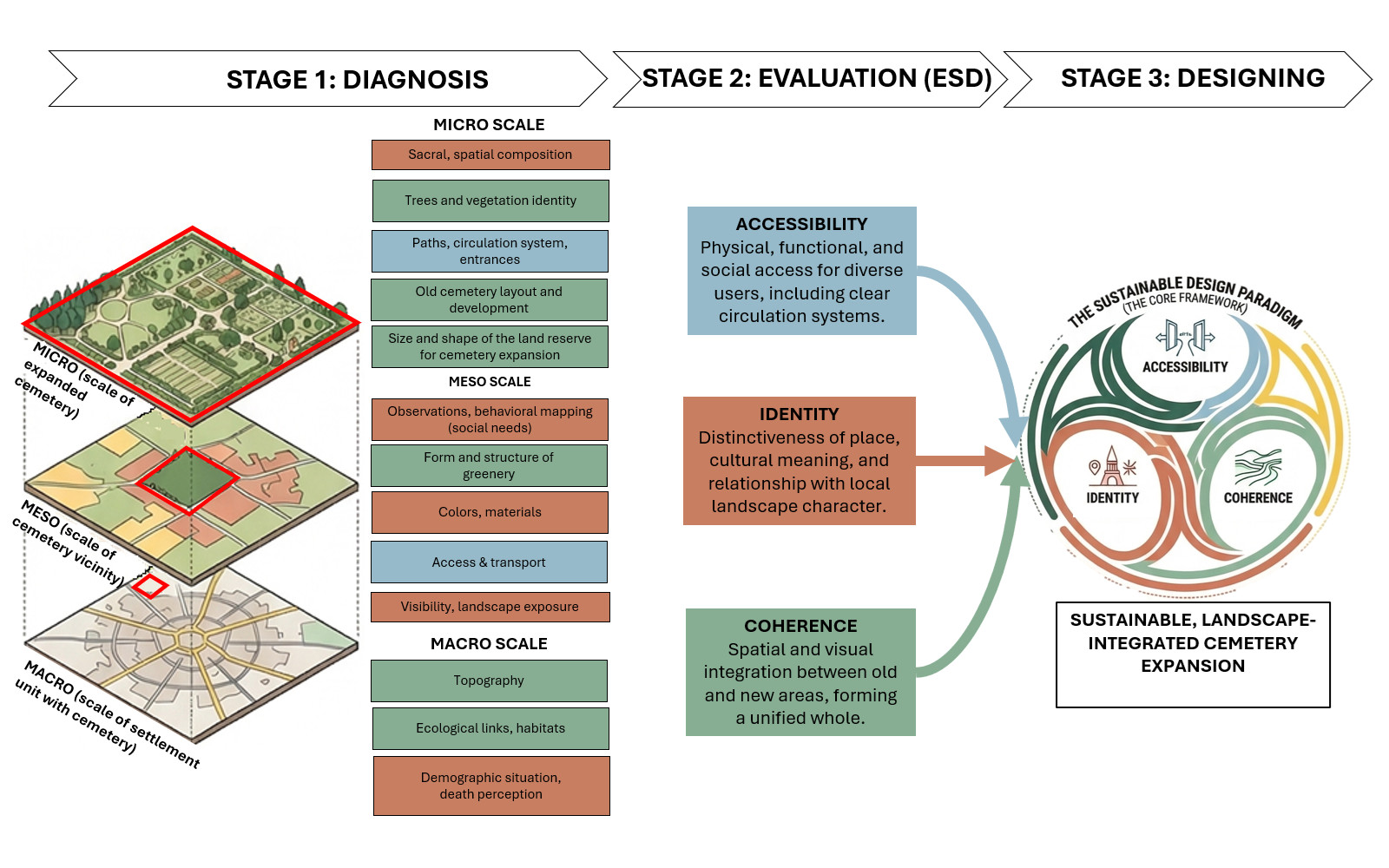
Cemetery is a multi-layered, specific space perceived as an essential component of sustainable development, contributing to the culture of space or the image of the settlement unit. Due to demographic trends and the current epidemiologic situation, the demand for burial sites has increased. Due to the lack of a commonly applied cemetery expansion strategy in Poland, new objects are often of low quality, leading to environmental degradation and a negative social perception of burial space. By the analysis of 34 selected extended cemeteries in France (11 objects), the Netherlands (9 objects), Germany (9 objects), and Slovenia (5 objects), some features of developed objects integrated with landscape and subsequently were applied while developing the concepts of three various Polish cemeteries demanding expansion. Based on this, a set of practical steps regarding the enlargement of these sites, according to the rules of sustainable development, was elaborated.
References
Act of 31 January 1959 on Cemeteries and Burial of the Deceased. http://prawo.sejm.gov.pl/isap.nsf/download.xsp/WDU19590110062/O/D19590062.pdf.
Act on Nature Conservation of 16 April 2004. http://prawo.sejm.gov.pl/isap.nsf/download.xsp/WDU20040920880/T/D20040880L.pdf
Allam, Z. (2023). On the sustainability of graveyards in urban milieus. The Palgrave Handbook of Global Sustainability DOI: https://doi.org/10.1007/978-3-031-01949-4_54
Antrop, M. (2006). Sustainable landscapes: contradiction, fiction or utopia? Landscape and Urban Planning, 75(3–4), 187–197. https://doi.org/10.1016/j.landurbplan.2005.02.014 DOI: https://doi.org/10.1016/j.landurbplan.2005.02.014
Ariès, Ph. (1981). The Hour of Our Death (1st ed.). New York, NY: Alfred A. Knopf.
Canning, L. & Szmigin, I. (2010). Death and disposal: The universal, environmental dilemma. Journal of Marketing Management, 26, 1129–1142. https://doi.org/10.1080/0267257X.2010.509580 DOI: https://doi.org/10.1080/0267257X.2010.509580
Capels, V. & Senville, W. (2006). Planning for cemeteries. Planning Commissioners Journal, 64, 1-8. Retrieved June 10, 2024 from https://plannersweb.com/wp-content/uploads/2006/10/230.pdf
CAUE, 2016. Conseil d’Architecture, d’Urbanisme et d’Environnement. Aménagement de cimetiére. Sommaire. Retrieved June 10, 2024 from https://www.caue60.com/wp-content/uploads/2016/10/Amenagement-de-cimetiere-web.pdf
Chen, X. & Wu, J. (2009). Sustainable landscape architecture: implications of the Chinese philosophy of “unity of man with nature” and beyond. Landscape Ecology, 24, 1015-1026. https://doi.org/10.1007/s10980-009-9350-z DOI: https://doi.org/10.1007/s10980-009-9350-z
Cheng, H.C. (2013). Uses of sacred spaces in urban neighborhoods: A study of cemeteries in Uptown Dallas. Retrieved June 17, 2024 from http://hdl.handle.net/10106/11891
Clayden, A., Hockey, J. & Powell, M. (2020). Cemeteries in the city: Spaces of care, heritage and nature. Routledge
Council of Europe. (2000). European Landscape Convention, Florence 2000. Retrieved 17 June, 2024 from https://www.coe.int/en/web/conventions/full-list?module=treaty-detail&treatynum=176
Davies, P.J. & Bennett, G. (2016). Planning, provision and perpetuity of deathscapes - Past and future trends and the impact for city planners. Land Use Policy, 55, 98-107. https://doi.org/10.1016/j.landusepol.2016.03.029 DOI: https://doi.org/10.1016/j.landusepol.2016.03.029
de Jonge, J. (2009). Landscape architecture between politics and science: an integrative perspective on landscape planning and design in the network society. [Doctoral Dissertation, Wageningen University]. https://core.ac.uk/download/pdf/29254506.pdf
Dekker, I. & Emaar, H. (2014). Begraafplaatsen in de Noordoostpolder. Retrieved June 17, 2026 from https://www.studiobladgroen.nl/toen/noordoostpolder
Dian, Z. (2004). Land for the dead, locating urban cemeteries: A case study of Guilin China [Master’s Thesis]. The International Institute for Geoinformation Science and Earth Observation Enschede Netherlands
Długoński, A., Dushkova, D. & Haase D. (2022). Urban cemeteries – Places of multiple diversity and challenges: A case study from Łódź (Poland) and Leipzig (Germany). Land, 11(5), 677. https://doi.org/10.3390/land11050677 DOI: https://doi.org/10.3390/land11050677
Długozima, A., Kosiacka-Beck, E., Królikowski, J.T., Rej, M., Rykała, E. & Żołnierczuk, M. (2020). The concept of development of the Czerwinsk’s Sanctuary of Our Lady of Consolation surrounding as a sacred-contemplative complex [Koncepcja zagospodarowania otoczenia Bazyliki Zwiastowania Najświętszej Marii Panny w Czerwińsku nad Wisłą jako zespołu sakralno-kontemplacyjnego]. Unpublished work
Długozima, A. & Kosiacka-Beck, E. (2020). How to Enhance the Environmental Values of Contemporary Cemeteries in an Urban Context. Sustainability, 12(6), 2374. https://doi.org/10.3390/su12062374 DOI: https://doi.org/10.3390/su12062374
Długozima, A. & Nejman R. (2022). Attractiveness of cemeteries versus socioeconomic and spatial development of non-metropolitan cities in Poland. Acta Scientiarum Polonorum Administratio Locorum, 21(1), 83–104. https://doi.org/10.31648/aspal.6824 DOI: https://doi.org/10.31648/aspal.6824
Długozima, A., Kosiacka-Beck, E. & Krzykawska, K. (2025). Multiuse Cemetery Paradigm: Cemetery as a multifunctional place of social significance – Reshaping a cemetery in the urban space of Eastern Europe. Cities, 156, 105556. https://doi.org/10.1016/j.cities.2024.105556 DOI: https://doi.org/10.1016/j.cities.2024.105556
Długozima, A. (2020). How might landscapes be better designed to accommodate increasing cremation practices in Europe?. Landscape Online, 87. https://doi.org/10.3097/LO.202087 DOI: https://doi.org/10.3097/LO.202087
Dziewulak, D. (2012). Burial of cremated human remains in cemeteries and other places in selected EU countries, Australia, Canada and the United States. Analizy BAS, 13(80)
Enache, C. & Craciun, C. (2013). The Role of the Landscape in the Identity Generation Process. Procedia - Social and Behavioral Sciences, 92, 309-313. https://doi.org/10.1016/j.sbspro.2013.08.677 DOI: https://doi.org/10.1016/j.sbspro.2013.08.677
Francis, D., Kellaher, L. & Neophytou, G. (2002). The Cemetery: A Site for the Construction of Memory, Identity, and Ethnicity. In J. Climo & M.G. Cattell (Eds.), Social memory and history: anthropological perspectives (p. 95-110). Walnut Creek, CA: AltaMira Press.
Francis, D., Kellaher, L. & Neophytou, G. (2000). Sustaining Cemeteries: The User Perspective. Mortality, 5(1), 34-52. https://doi.org/10.1080/713685994 DOI: https://doi.org/10.1080/713685994
Franco, D.S., Georgin, J., Villarreal Campo, L.A., Oliveira, M.L. & Ramos, C.G. (2022). The environmental pollution caused by cemeteries and cremations: A review. Chemosphere, 307, 136025. https://doi.org/10.1016/j.chemosphere.2022.136025 DOI: https://doi.org/10.1016/j.chemosphere.2022.136025
Gao, Q., Woods, O., Kong, L. (2023). The Political Ecology of Death: Chinese Religion and The Affective Tensions of Secularised Burial Rituals in Singapore. Environment and Planning E: Nature and Space. https://doi.org/10.1177/25148486211068475 DOI: https://doi.org/10.1177/25148486211068475
Goyvaerts S., Vande Keere N. 2020. Liturgy and Landscape—Re-Activating Christian Funeral Rites through Adaptive Reuse of a Rural Church and Its Surroundings as a Columbarium and Urn Cemetery. Religions, 11(8), 1-13.
Goyvaerts, S. & Vande Keere, N. (2020). Liturgy and Landscape – Re-Activating Christian Funeral Rites through Adaptive Reuse of a Rural Church and Its Surroundings as a Columbarium and Urn Cemetery. Religions, 11(8), 1-13. https://doi.org/10.3390/rel11080407 DOI: https://doi.org/10.3390/rel11080407
Grabalov, P. & Nordh, H. (2022). The future of urban cemeteries as public spaces: Insights from Oslo and Copenhagen. Planning Theory Practice 23, 81–98. https://doi.org/10.1080/14649357.2021.1993973 DOI: https://doi.org/10.1080/14649357.2021.1993973
Harvey, T. (2006). Sacred Spaces, Common Places: The Cemetery in the Contemporary American City. Geographical Review, 96, 295–312. https://doi.org/10.1111/j.1931-0846.2006.tb00054.x DOI: https://doi.org/10.1111/j.1931-0846.2006.tb00054.x
Huang, J., Nitivattananon, V., Lin, D. & Gong, W. (2023). Integrated assessment for Sustainable Development Goals of metropolitan regions: A case study of the Pearl River Delta region, China. Environmental and Sustainability Indicators, 20, 100299. https://doi.org/10.1016/j.indic.2023.100299 DOI: https://doi.org/10.1016/j.indic.2023.100299
ICS (2024). International Cremation Statistics. Retrieved 17 June, 2026 from https://www.cremation.org.uk/International-cremation-statistics-2024
Iswoyo, H., Farid, M., Nurfaida, N., Dariati, T., Faried, M., Djufrie, A.B., Amri, M. & Haya, M. (2025). Spaces for the living and the dead: Optimising cemeteries as sustainable urban green spaces. JOURNAL OF WATER AND LAND DEVELOPMENT, No. 66 (VII–IX), 162–175. https://doi.org/10.24425/jwld.2025.155312 DOI: https://doi.org/10.24425/jwld.2025.155312
Jaszczak, A., Kostecki, J., Pochodyła-Ducka, E. & Greinert, A. (2025). Cemeteries as Sustainable Elements of Urban Green Space: Legal, Ecological, and Spatial Perspectives from Central and Eastern Europe. Sustainability. 18(1), 212. https://doi.org/10.3390/su18010212 DOI: https://doi.org/10.3390/su18010212
Kaplan, R. & Kaplan, S. (1989). The Experience of Nature: A Psychological Perspective; Cambridge University Press: Cambridge, New York
Kaymaz, I. (2013). Urban Landscapes and Identity. In M. Özyavuz (Ed.), Advances in Landscape Architecture (1st ed.). Intech Open. Retrieved 10 June, 2024 from https://www.intechopen.com/chapters/45403. DOI: https://doi.org/10.5772/55754
Kilbane, S. (2025). Beyond Terrain Vague: Future Cemetery/Memorial Parks as Critical Green Space in Changing Cities. Fábos Conference on Landscape and Greenway Planning 8(1). https://doi.org/10.7275/fabos.2411
Klaver, E. (2015). The Cemetery as Public Space: Spoon River Anthology and Act 3 of Our Town. Genre, 48(1), 99–118. https://doi.org/10.1215/00166928-2837308 DOI: https://doi.org/10.1215/00166928-2837308
Klingemann, H. (2022). Cemeteries in transformation – A Swiss community conflict study, Urban Forestry & Urban Greening, 76, 127729. https://doi.org/10.1016/j.ufug.2022.127729 DOI: https://doi.org/10.1016/j.ufug.2022.127729
Kosiacka-Beck, E., Królikowski, J.T., Długozima, A., Rykała, E.A. & Sikora, D. (2021). The Development of Czerwińsk as a Continuation of History. Prospects for the Future. Ochrona Zabytków, 2, 47-87.
Krause, C. L. (2001). Our visual landscape: Managing the landscape under special consideration of visual aspects. Landscape and Urban Planning, 54(1–4), 239–254. https://doi.org/10.1016/S0169-2046(01)00138-6 DOI: https://doi.org/10.1016/S0169-2046(01)00139-6
Kubiak, A.E., Długozima, A. & Wedeł-Domaradzka A. (2023). Death and Funeral Practices in Poland, Routledge Series, Taylor & Francis, London DOI: https://doi.org/10.4324/9781003207634
Kuiper, J. (1998). Landscape quality based upon diversity, coherence and continuity: Landscape planning at different planning-levels in the River area of the Netherlands, Landscape and Urban Planning, 43(1–3), 111-120. https://doi.org/10.1016/S0169-2046(98)00075-9 DOI: https://doi.org/10.1016/S0169-2046(98)00075-9
Kuźniar, A. (2025). Cremations Already Account for 40% of Burials in Poland — Unique Urns Growing in Popularity [W Polsce kremacje stanowią 40 procent pochówków. Polacy coraz częściej wybierają też unikatowe urny]. Retrieved 8 March, 2026 from https://www.pap.pl/aktualnosci/news%2C1468042%2Cw-polsce-kremacje-stanowia-40-procent-pochowkow-polacy-coraz-czesciej
Lai, K. Y., Sarkar, C., Sun, Z. & Scott, I. (2020). Are greenspace attributes associated with perceived restorativeness? A comparative study of urban cemeteries and parks in Edinburgh, Scotland. Urban Forestry & Urban Greening, 53, 126720. https://doi.org/10. 1016/j.ufug.2020.126720 DOI: https://doi.org/10.1016/j.ufug.2020.126720
Lai, K.Y., Scott, I. & Sun, Z. (2019). Everyday Use of the City Cemetery: A Study of Environmental Qualities and Perceived Restorativeness in a Scottish Context. Urban Sci., 3, 72. https://doi.org/10.3390/urbansci3030072 DOI: https://doi.org/10.3390/urbansci3030072
Mathijssen B., 2025. Mapping nature burial in the Netherlands (2003–2023). Mortality, 30(4), 1145-1176. https://doi.org/10.1080/13576275.2025.2449904 DOI: https://doi.org/10.1080/13576275.2025.2449904
McClymont, K. & Sinnett, D. (2021). Planning cemeteries: Their potential contribution to green infrastructure and ecosystem services. Frontiers in Sustainable Cities, 3, 789925. https://doi.org/10.3389/frsc.2021.789925 DOI: https://doi.org/10.3389/frsc.2021.789925
Moesch, S., Ladds, Z. & Francis, R.A. (2024). Life in the deadlands: unearthing reasons for visiting and visitor perceptions of wildlife in London’s Magnificent Seven cemeteries. Journal of Urban Ecology, 10(1), juae022. https://doi.org/10.1093/jue/juae022 DOI: https://doi.org/10.1093/jue/juae022
Moonen, J. (2009). Cemetery for the City. Creating an Urban Integrated Cemetery for the City of Maassluis (The Netherlands) [Master Thesis, TU Delft]. https://repository.tudelft.nl/file/File_d408229c-dab7-4d5e-ba54-2420d290dcf8?preview=1
Neckel, A., Costa, C., Nunes Mario, D., Saggin Sabadin, C.E. & Bodah, E.T. (2017). Environmental damage and public health threat caused by cemeteries: a proposal of ideal cemeteries for the growing urban sprawl. urbe. Revista Brasileira de Gestão Urbana (Brazilian Journal of Urban Management), 9(2), 216-230. https://doi.org/10.1590/2175-3369.009.002.AO05 DOI: https://doi.org/10.1590/2175-3369.009.002.ao05
Nguyen, T. & Nguyen, L. (2018). Groundwater pollution by longstanding cemetery and solutions for urban cemetery planning in Ho Chi Minh City – From reality to solutions, MATEC Web of Conferences, EDP Sciences, 193, 02008. https://doi.org/10.1051/matecconf/201819302008. DOI: https://doi.org/10.1051/matecconf/201819302008
Nwambuonwo, S.E. & Agwu, K.D. (2024). Sustainable Approaches to Cemetery Design in Urban Areas: Asaba as A Case Study. IIARD International Journal of Geography & Environmental Management, 10(11). https://doi.org/10.56201/ijgem.v10.no11.2024.pg59.73
Okumus, D.E. & Terzi, F. (2023). Ice floes in urban furnace: Cooling services of cemeteries in regulating the thermal environment of Istanbul's urban landscape. Urban Climate, 49, 101549. https://doi.org/10.1016/j.uclim.2023.101549 DOI: https://doi.org/10.1016/j.uclim.2023.101549
Oyeleke, O. & Oloukoi, G. (2024). Sustainability Practices in Urban Cemetery Management. Path of Science: International Electronic Scientific Journal, 10(4). https://doi.org/10.22178/pos.103-5 DOI: https://doi.org/10.22178/pos.103-5
Page, J. & Besco, L. (2025). Cemeteries as critical social infrastructure: A comparative legal geography, Cities, 160, 105792. https://doi.org/10.1016/j.cities.2025.105792 DOI: https://doi.org/10.1016/j.cities.2025.105792
Palánová, K. & Juraka, O. (2018). Sustainability of existing areas of historic cemeteries in the city organism: A Czech case study. IOP Conference Series: Earth and Environmental Science, 143, 1-8. DOI: https://doi.org/10.1088/1755-1315/143/1/012052
1088/1755-1315/143/1/012052
Pathak, S. & Mishra, R. (2025). Ritual Ecologies: Analyzing the Environmental Impact and Cultural Sustainability of Death Practices Across Civilizations through Selected Case Studies. EPJ Web of Conferences. https://doi.org/10.1051/epjconf/202532801063 DOI: https://doi.org/10.1051/epjconf/202532801063
Pilarczyk, A. & Nowak, P. (2019). Factors Determining the Ways for Shaping the Landscapes of Municipal Cemeteries in Szczecin: Proposals of Changes in the Shaping of Municipal Cemeteries. IOP Conference Series: Materials Science and Engineering, 471, 1–9. https://doi.org/10.1088/1757-899X/471/9/092057 DOI: https://doi.org/10.1088/1757-899X/471/9/092057
Puzdrakiewicz, K. (2020). Cemeteries as (un)wanted heritage of previous communities. An example of changes in the management of cemeteries and their social perception in Gdańsk, Poland. Landscape Online 86, 1–26. https://doi.org/10.3097/LO.202086 DOI: https://doi.org/10.3097/LO.202086
Puzdrakiewicz, K. (2023). To what extent are cities prepared for their residents’ deaths? An example of cemetery management in large polish cities. Land Use Policy, 129, 106646. https://doi.org/10.1016/j.landusepol.2023.106646 DOI: https://doi.org/10.1016/j.landusepol.2023.106646
Quinton, J. M., Duinker, P. N., Steenberg, J. W. N. & Charles, J. D. (2020). The living among the dead: Cemeteries as urban forests, now and in the future. Urban Forestry Urban Greening 48, 126564. https://doi.org/10.1016/j.ufug.2019.126564. DOI: https://doi.org/10.1016/j.ufug.2019.126564
Rae, R. A. (2021). Cemeteries as public urban green space: Management, funding and form. Urban Forestry & Urban Greening, 61, 127078. https://doi.org/10.1016/j.ufug.2021.127078 DOI: https://doi.org/10.1016/j.ufug.2021.127078
Rej, M. (2014). Development of columbaria in the South Communal Cemetery in Antoninów near Warsaw [Projekt założenia kolumbariów na Cmentarzu Południowym Komunalnym w Antoninowie pod Warszawą]. Engineering Thesis, supervisor Anna Długozima, WULS-SGGW
Rugg, J. (2000). Defining the place of burial: What makes a cemetery a cemetery? Mortality, 5, 259–275. https://doi.org/10.1080/713686011 DOI: https://doi.org/10.1080/713686011
Sallay, Á., Mikházi, ZS., Gecséné Tar, I. & Takács, K. (2022). Cemeteries as a Part of Green Infrastructure and Tourism. Sustainability, 14, 2918. https://doi.org/10.3390/su14052918 DOI: https://doi.org/10.3390/su14052918
Sallay, Á., Tar, I.G., Mikházi, Z., Takács, K., Furlan, C. & Krippner, U. (2023). The Role of Urban Cemeteries in Ecosystem Services and Habitat Protection. Plants (Basel), 12(6), 1269. https://doi.org/10.3390/plants12061269 DOI: https://doi.org/10.3390/plants12061269
Säumel, I., Butenschön, S. & Kreibig, N. (2023). Gardens of life: Multifunctional and ecosystem services of urban cemeteries. Frontiers in Environmental Science, 10, 1077565. https://doi.org/10.3389/fenvs.2022.1077565 DOI: https://doi.org/10.3389/fenvs.2022.1077565
Scalenghe, R. & Pantani, O.L. (2020). Connecting existing cemeteries saving good soils (for livings), Sustainability, 12, 93. https://doi.org/10.3390/su12010093 DOI: https://doi.org/10.3390/su12010093
Sierzan, W. (2015). Rural cemetery design integrated with the sourrounding landscape [Projekt zagospodarowania cmentarza wiejskiego zintegrowanego z krajobrazem]. Engineering Thesis, supervisor Anna Długozima, WULS-SGGW
Stobbelaar, D. & Pedroli, B. (2011). Perspectives on Landscape Identity: A Conceptual Challenge, Landscape Research, 36(3), 321-339. https://doi.org/10.1080/01426397.2011.564860 DOI: https://doi.org/10.1080/01426397.2011.564860
Straka, T. M., Mischo, M., Petrick, K. J. S. & Kowarik, I. (2022). Urban Cemeteries as Shared Habitats for People and Nature: Reasons for Visit, Comforting Experiences of Nature, and Preferences for Cultural and Natural Features. Land, 11(8), 1237. https://doi.org/10.3390/land11081237 DOI: https://doi.org/10.3390/land11081237
Stumpe, B., Stuhrmann, N., Jostmeier, A. & Marschner, B. (2024). Urban cemeteries: The forgotten but powerful cooling islands. Science of The Total Environment, Vol. 934, 173167. https://doi.org/10.1016/j.scitotenv.2024.173167 DOI: https://doi.org/10.1016/j.scitotenv.2024.173167
Szukalski, P. (2023). Mortality In A.E. Kubiak, A. Długozima, A. Wedeł-Domaradzka (Eds.), Death and Funeral Practices in Poland, Routledge, Taylor & Francis DOI: https://doi.org/10.4324/9781003207634-3
UN (2015). The 2030 Agenda for Sustainable Development. Retrieved 10 March, 2026 from https://www.un.org.pl/agenda-2030-rezolucja
Thompson, J.W. & Sorvig, K. (2008). Sustainable Landscape Construction: A Guide to Green Building Outdoors. Washington, London, Covelo: Island Press
UNESCO, 2011. Recommendation On The Historic Urban Landscape. Retrieved 7 March, 2025 from https://whc.unesco.org/uploads/activities/documents/activity-638-98.pdf
Uzzell, D., Pol, E. & Badenas, D. (2002). Place identification, social cohesion, and environmental sustainability. Environment and Behavior, 34(1), 26-53. https://doi.org/10.1177/0013916502034001003 DOI: https://doi.org/10.1177/0013916502034001003
Van der Breemer, R. (2021). Governing Cemeteries. State Responses to the New Diversity in The Netherlands, Norway and France, Vandenhoeck & Ruprecht, Göttingen DOI: https://doi.org/10.13109/9783666567322
Weisenhorn, J., Ripp, T. & Vaughan, E. (2018). SULIS: Sustainable Urban Landscape Information Series – Design. Retrieved 10 March, 2025 from https://conservancy.umn.edu/bitstream/handle/11299/202985/SULIS%20DESIGN.pdf?sequence=1&isAllowed=y.
Wilkinson, S., Biskup, B. & Reagan, N. (2017). Hazelwood Cemetery Visioning Project Report. Retrieved 10 March, 2025 from https://www.springfieldmo.gov/DocumentCenter/View/31938/Hazelwood-Cemetery-Visioning-Final-Report?bidId=
Worpole, K. (2003). Last Landscapes. The Architecture of the Cemetery in the West (1st ed.). London: Reaktion Books
Downloads
Published
How to Cite
Issue
Section
License
Copyright (c) 2026 Anna Długozima

This work is licensed under a Creative Commons Attribution 4.0 International License.