Negative Consequences of Suburbanisation on Architectural Cohesion in Indigenous Villages Absorbed by Expanding Post-Socialist Cities: The Cases of Kraków and Lviv
DOI:
https://doi.org/10.3097/LO.2025.1143Keywords:
village absorption, building cohesion method, spatial and architectural transformation, urban sprawl, cultural landscape and heritage preservation, critical zone of spatial changeAbstract
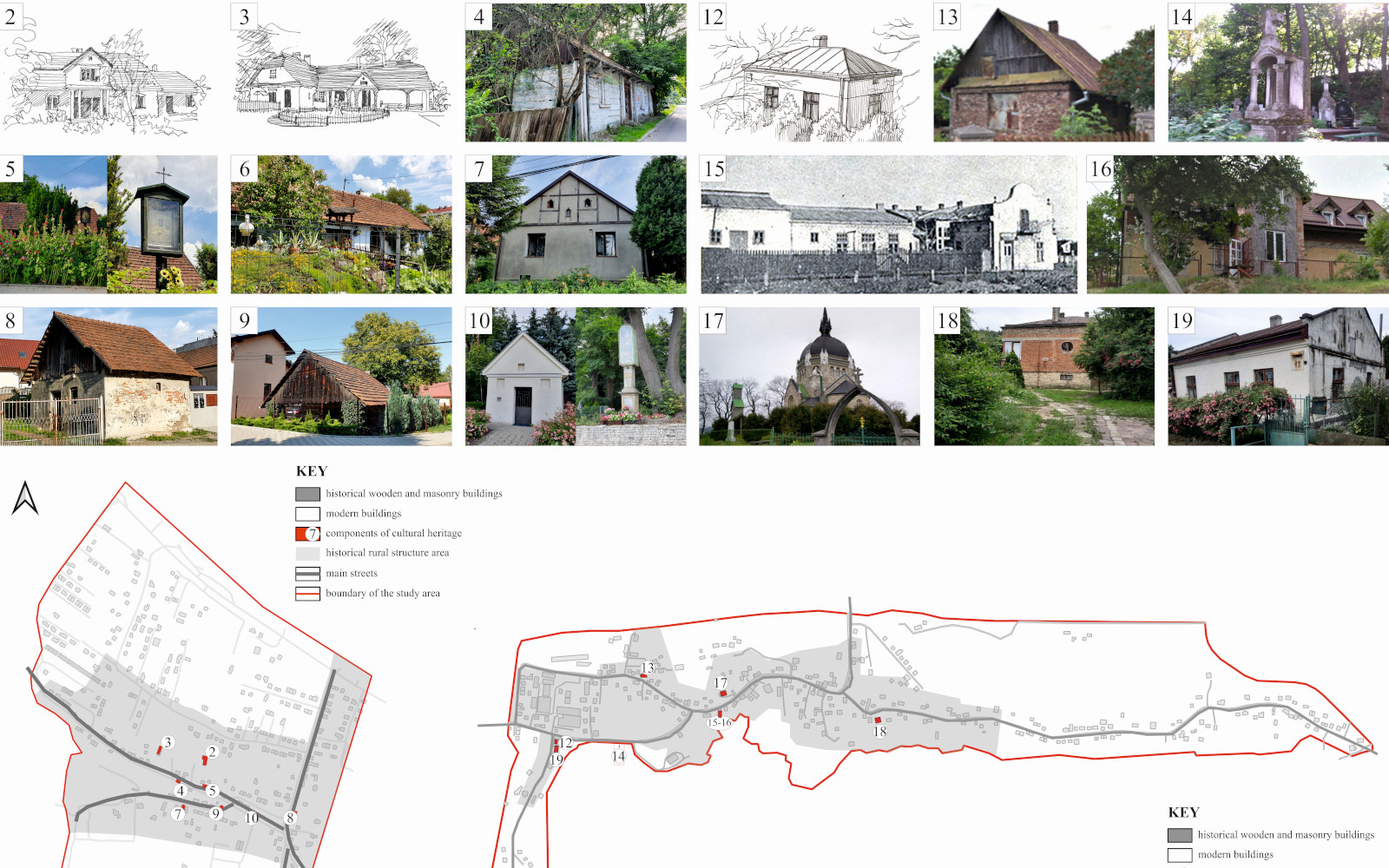
The historical cultural landscape of villages absorbed into expanding urban areas is being lost amid the multiplication of rapidly developing modern housing estates. This process is particularly pronounced in post-socialist cities such as Krakow and Lviv. The urban -architectural features of the former villages – such as building layouts, form and height, timberwork, façade materials and colours, roof types, architectural details, and the character of their immediate surroundings - once reflected a rural residential model rooted in agricultural traditions, notably in the Bronowice and Znesinnya districts. This traditional model is increasingly eroded by dynamic urban change, technological progress, and investment pressure. Consequently. Through analysis of historical documents, iconography, and cartographic materials, complemented by research field inventory, a model of traditional suburban village architecture was developed. Employing the author’s ‘building cohesion’ methodology, a detailed field inventory was conducted, and a critical zone for cultural heritage was delineated within Bronowice—a district experiencing intense development pressures. Drawing on findings from Bronowice, two development scenarios were projected for Znesinnya: one advocating harmonious, sustainable growth that respects the traditional village layout; and a second, pessimistic scenario forecasting unregulated development similar to that in Bronowice. The forecasts suggest that, without preventive legal and planning interventions, as well as both top-down and grassroots initiatives to promote awareness of the area’s rural origins, Znesinnya is likely to follow a similar trajectory of cultural landscape degradation.
References
Agnoletti M., Emanueli F., Corrieri F., Venturi M. (2019). Monitoring traditional rural landscape. The case study of Italy. Sustainability 2019, 11(21), 6107, https://doi.org/10.3390/su11216107 DOI: https://doi.org/10.3390/su11216107
Balta, S., Atik, M. (2022). Rural planning guidelines for urban-rural transition zones as a tool for the protection of rural landscape characters and retaining urban sprawl: Antalya case from Mediterranean, Land Use Policy, 119, 106144. https://doi.org/10.1016/j.landusepol.2022.106144 DOI: https://doi.org/10.1016/j.landusepol.2022.106144
Cegielska K., Salata T. (2023). A multimetric approach to antropogenic pressure analyses: A tool for measuring and mapping the human impact on the landscape. Land Degradation & Development, 2023, vol. 34, https://doi.org/10.1002/ldr.4845 DOI: https://doi.org/10.1002/ldr.4845
Cegielska K., Różycka-Czas R., Gorzelany J., Olczak B. (2025). Land use and land cover conflict risk assessment model: Social and spatial impact of suburbanisation. Landscape and Urban Planning, 2025, vol. 257, https://doi.org/10.1016/j.landurbplan.2025.105302 DOI: https://doi.org/10.1016/j.landurbplan.2025.105302
Cerise, E., Fanchette, S., Labbé, D., Boudreau, J.-A., & Nhật Kiên, T. (2016). Chapter 3. Expansion of the city through integration of urban villages. In S. Fanchette (éd.), Hà Nội, a Metropolis in the Making (1). IRD Éditions. https://doi.org/10.4000/books.irdeditions.26202 DOI: https://doi.org/10.4000/books.irdeditions.26202
Chen, Z. F., Li, Y. R., Liu, Y. S., Liu, X. Q. (2021). Does rural residential land expansion pattern lead to different impacts on eco-environment? A case study of loess hilly and gully region, China. Habitat International. 117, 102436. DOI: https://doi.org/10.1016/j.habitatint.2021.102436
Delgado-Viñas C., Gómez-Moreno M.-L. (2022). The integration between urban and rural areas: an updated paradigmatic, methodological and bibliographic review. Land 2022, 11(8), 1298, https://doi.org/10.3390/land11081298 DOI: https://doi.org/10.3390/land11081298
Dymek, D., & Bednorz, L. (2016). Coexistence with a City as a Threat to the Identity of a Former Suburban Village of Morasko Near Poznań, Poland. Badaia Fizjograficzne, 67, 31–42.
Gnatiuk, O. (2017). Demographic dimension of suburbanization in Ukraine in the light of urban development theories, Auc Geographica 52(2):151-163. DOI: https://doi.org/10.14712/23361980.2017.12
Gnatiuk O., Mezentsev K., Provotar N. (2021). From the agricultural station to a luxury village? Changing everyday practices in the suburb of Vinnytsia, Ukraine. Land, 10(1), 48. https://doi.org/10.3390/land10010048 DOI: https://doi.org/10.3390/land10010048
Grabiński, T. (1992). Metody taksonometrii [In Polish]. In Pracownia Pomocy Naukowo-Dydaktycznych Akademii Ekonomicznej w Krakowie.
Haase, A., Wolff, M., Špačková, P., & Radzimski, A. (2017). Reurbanisation in Postsocialist Europe-A Comparative View of Eastern Germany, Poland and Czech Republic. Comparative Population Studies, 42, 353–390. https://doi.org/10.12765/CPoS-2018-02 DOI: https://doi.org/10.12765/CPoS-2018-02
Habrel M., Denis M., Majewska A., Habrel M., Izdebski M., Fenchuk O. (2024). Delimitation of the metropolitan areas of Warsaw and Lviv over the last 100 years: The PolishUkrainian experience. Cities 144, 104664, 1-10. https://doi.org/10.1016/j.cities.2023.104664 DOI: https://doi.org/10.1016/j.cities.2023.104664
Hirt, S. (2006). Post-Socialist Urban Forms: Notes From Sofia. Urban Geography, 27(5), 464–488. https://doi.org/10.2747/0272-3638.27.5.464 DOI: https://doi.org/10.2747/0272-3638.27.5.464
Ianoș I., Cocheci R-M., Petrișor A-I. (2024). Exploring the relationship between the dynamics of the urban-rural interface and regional development in a post-socialisttransition, Urban Science, 2024, 8(2), 47, https://doi.org/10.3390/urbansci8020047 DOI: https://doi.org/10.3390/urbansci8020047
Kertész, Á., Nagy, L. A., Balázs, B. (2019). Effect of land use change on ecosystem services in Lake Balaton Catchment. Land Use Policy. 80, 430-438. https://doi.org/10.1016/j.landusepol.2018.04.005 DOI: https://doi.org/10.1016/j.landusepol.2018.04.005
Kovács Z., Farakas J.Z., Egedy T., Kondor A.C. 2019. Urban sprawl and land conversion in post-socialist cities: The case of metropolitan Budapest. Cities 92(1), 71-81. https://doi.org/10.1016/j.cities.2019.03.018 DOI: https://doi.org/10.1016/j.cities.2019.03.018
Leetmaa, K., Brade, I., Anniste, K., & Nuga, M. (2012). Socialist Summer-home Settlements in Post-socialistSuburbanisation. Urban Studies, 49(1), 3–21. https://doi.org/10.1177/0042098010397399 DOI: https://doi.org/10.1177/0042098010397399
Lokšová T., Galčanová Batista L. (2021). Postsocialis suburban governmentality: A shift from reactive to proactive discourse in the case of Brno, Czech Republic, Cities 110 (2021) 103074 https://doi.org/10.1016/j.cities.2020.103074 DOI: https://doi.org/10.1016/j.cities.2020.103074
Lorens, P. (2005). Suburbanisation in the growth of a post-socialist city. In The problem of suburbanisation (pp. 34–44).
Majewska, A., Denis M., Krupowicz W. (2020). Urbanization chaos of suburban small cities in Poland: ‘Tetris Development’, Land 2020, 9(11), 461; https://doi.org/10.3390/land9110461 DOI: https://doi.org/10.3390/land9110461
Mezentseva, K. et al. (2017). Urbanistychna Ukraina: v epitsentri prostorovykh zmin : monohrafiia / za red. Kyiv: Vydavnytstvo «Feniks», 2017. – 438 s. ISBN 978-966-136-446-1
Olczak, B., Wilkosz-Mamcarczyk, M., Prus, B., Hodor, K., & Dixon-Gough, R. (2022). Application of the building cohesion method in spatial planning to shape patterns of the development in a suburban historical landscape of a “village within Krakow.” Land Use Policy, 114(January 2021), 105997. https://doi.org/10.1016/j.landusepol.2022.105997 DOI: https://doi.org/10.1016/j.landusepol.2022.105997
Posatsky, B. (2014). Spatial transformation of Lviv centre (plans and realizations in 20th and in the early years of 21st century). Budownictwo, 20, 203–2018.
Posatsky, B. (2016). Residential areas in townscape of Lviv (in the second half of the 20th – and the beginning of the 21st centuries). Space-Society-Economy, 15, 11–12.
Purchla, J. (2003). Krakow and Lviv. Variability of relations in the nineteenth and twentieth centuries.
Raszeja, E. (2007). Interpreting the Rural Landscape – Between Theory and Practice. Czasopismo Techniczne, 5-A, 75–7.
Różycka-Czas, R., Czesak, B., Staszel, A. (2021). Which Polish Cities Sprawl the Most. Land 10, no. 12: 1291. https://doi.org/10.3390/land10121291 DOI: https://doi.org/10.3390/land10121291
Sandu, A. 2024. The post-socialist cities from Central and Eastern Europe: Between spatial growth and demographic decline. Urban Studies 61(5), 821-837, https://doi.org/10.1177/00420980231189261 DOI: https://doi.org/10.1177/00420980231189261
Sardaro, R., La Sala, P., De Pascale, G. & Faccilongo, N. (2021). The conservation of cultural heritage in rural areas: Stakeholder preferences regarding historical rural buildings in Apulia, southern Italy. Land Use Policy, 109, 105662. https://doi.org/10.1016/j.landusepol.2021.105662 DOI: https://doi.org/10.1016/j.landusepol.2021.105662
Schmidt, S., Fina, S. & Siedentop, S. (2014). Post-socialist Sprawl: A Cross-Country Comparison. European Planning Studies, 23(7), 1357–1380. https://doi.org/10.1080/09654313.2014.933178 DOI: https://doi.org/10.1080/09654313.2014.933178
Stanilov, K. (2007). The Post-Socialist City, Urban Form and Space Transformations in Central and Eastern Europe after Socialism. https://doi.org/10.1007/978-1-4020-6053-3 DOI: https://doi.org/10.1007/978-1-4020-6053-3
Swensen G. (2012). Integration of historic fabric in new urban development—A Norwegian case-study. Landscape and Urban Planning, 2012, vol. 107, https://doi.org/10.1016/j.landurbplan.2012.07.006 DOI: https://doi.org/10.1016/j.landurbplan.2012.07.006
Sýkora, L. & Bouzarovski, S. (2011). Multiple transformations. Urban Studies, 49(1), 43–60. https://doi.org/10.1177/0042098010397402 DOI: https://doi.org/10.1177/0042098010397402
Szmytkie, R. (2020). The impact of residential suburbanization on changes in the morphology of villages in the suburban area of Wrocław, Poland. Environmental & Socio-economic Studies, 8(4), 24–43. https://doi.org/10.2478/environ-2020-0021 DOI: https://doi.org/10.2478/environ-2020-0021
Tsenkova, S., & Nedović-Budić, Z. (2006). The post-socialist urban world. In The Urban Mosaic of Post-Socialist Europe, Space, Institutions and Policy (pp. 349–365). DOI: https://doi.org/10.1007/3-7908-1727-9
Report (2006). Urban sprawl in Europe EEA Report No 10/2006 ISSN 1725-9177
Wilkosz-Mamcarczyk, M., Olczak, B., Prus, B. (2020). Urban features in rural landscape: a case study of the municipality of skawina. Sustainability 12 (11), 4638. https://doi.org/10.3390/su12114638 DOI: https://doi.org/10.3390/su12114638
Wilkosz-Mamcarczyk, M., & Rajca, J. (2021). Vanishing rural views of Lesser Poland landscapes. In Katalog Dziedzictwa kulturowego Małopolski (pp. 149–164).
Węcławowicz, G. (2016) Urban Development in Poland from the Socialist City to the Post-Socialist and Neoliberal City. In ‘Artificial towns’ in the 21st Century. Social polarisation in the new town regions of East-Central Europe, 65-82.
Downloads
Published
How to Cite
Issue
Section
License
Copyright (c) 2025 Magdalena Wilkosz-Mamcarczyk, Barbara Olczak, Barbara Prus, Katarzyna Hodor, Nadija Sosnova

This work is licensed under a Creative Commons Attribution 4.0 International License.